

How Kamehameha Schools Achieved Early Adoption and Integration Success
As organizations modernize their finance operations, embedded payments and automation are becoming just as critical as core ERP functionality. During Kamehameha Schools’ transition from PeopleSoft to Oracle Fusion Cloud ERP and EPM, one capability stood out as both high impact and forward-looking: the implementation of J.P. Morgan (JPM) virtual cards for supplier payments through Oracle Cloud’s embedded banking integration.
This initiative positioned Kamehameha Schools (KS) as one of the first organizations to implement Oracle’s embedded JPM virtual card solution, and Elire as one of the first global implementers to successfully deliver it.
A New Generation of Virtual Card Integration
Unlike legacy virtual card solutions that required custom integrations or third-party tooling, Oracle’s JPM virtual card capability is embedded directly within Oracle Fusion Cloud. With the 25A solution, once you have a card program in place with the participating banks, you can easily configure the virtual card functionality in Cloud ERP as part of the standard Invoice-to-Payment process. The functionality is delivered through Oracle’s bank integration framework and designed to work seamlessly with Oracle Payables processes.
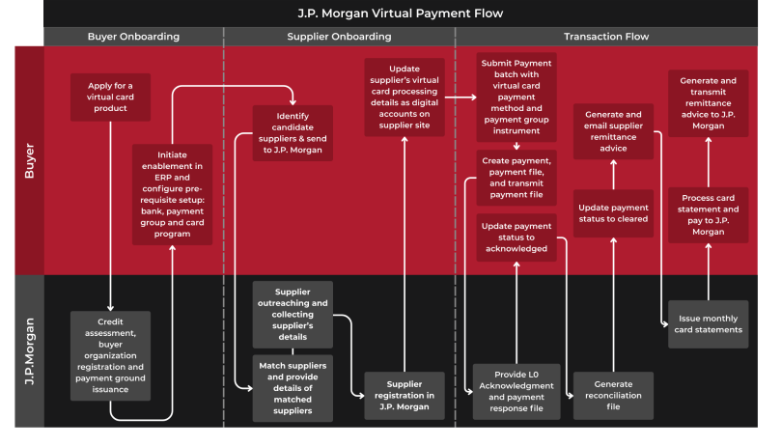
Oracle Cloud J.P. Morgan virtual card payment flow
This flow illustrates how buyer onboarding, supplier enablement, payment execution, card settlement, and reconciliation occur between Oracle Cloud and J.P. Morgan using delivered integration points. Rather than relying on custom development, the process leverages Oracle’s native payment framework, allowing virtual cards to function as a fully embedded part of Payables operations.
For KS, this represented a significant advancement from prior approaches. The virtual card program was not rebuilt or re-engineered during the migration; instead, it transitioned cleanly alongside the move from PeopleSoft to Oracle Cloud, preserving continuity while introducing new efficiencies.
Because this product is newly released, the implementation required close coordination across Elire, J.P. Morgan, Kamehameha Schools, and Oracle’s product team. These relationships were extremely valuable as this project was one of the first Oracle-J.P. Morgan Card Payment implementations ever completed.
Kamehameha Schools’ supplier payment process benefited from these partnerships, especially during rollout and post go-live support. For example, shortly after go-live KS identified additional use cases facing system limitations. To address this, KS collaborated with Elire, J.P. Morgan, and Oracle to implement a solution that not only solved the issue, but also greatly benefited the product’s larger-scale operations and its users. The project team’s close relationship with Oracle’s and J.P. Morgan’s implementation team deeply contributed to the success of this project. As Elire continues to support existing and new customers, this relationship fosters opportunities to provide product feedback and influence features as the capability continues to mature.
Why Choose to Pay Supplier Invoices with Virtual Cards in ERP?
There are multiple business advantages to using credit for supplier payments instead of traditional cash-based methods such as checks, ACH, or wire transfers. Kamehameha Schools identified this opportunity as a strategic solution to help improve cash flow by paying suppliers according to agreed terms while utilizing credit lines and settling with the bank at a later date. In fact, many banks provide financial rebates on virtual card transactions, transforming the Accounts Payable from a cost center into a potential revenue generator.
Since going live, Kamehameha Schools has actively adopted the virtual card solution in production. In addition to automation benefits, the program generates rebate revenue tied directly to card usage.
The virtual card programs typically return a percentage of spend as rebates. As a hypothetical example, $1,000,000 in monthly card volume at a 2% rebate rate would result in $20,000 in cashback in revenue.
As payments become more digitized and automated worldwide, an increasing number of suppliers accept card payments. The benefit of this: suppliers receive funds faster and more securely without sharing their bank account details. Additionally, by issuing virtual cards at suppliers’ request, buyers help reinforce their supply chain ecosystem.
Payment automation and rebate revenue are just two ways KS is using virtual cards as an active, embedded part of its payables strategy.
Key Drivers Behind the JPM Virtual Card Success
Both project teams guided the end-to-end implementation, ensuring the solution aligned with Kamehameha Schools Oracle Payables configuration and broader Cloud architecture. Several factors contributed to the overall success of this initiative:
Early Adopter Mindset
By embracing Oracle’s embedded virtual card functionality early on, KS accelerated the modernization of its payables process while actively collaborating with Oracle and J.P. Morgan Chase to help shape and refine the solution. Kamehameha Schools positioned the organization as a strong example of engagement, partnership, and openness to learning throughout the entire ERP implementation, demonstrating a proactive and forward-thinking approach to system adoption.
Strong Partnership
Close, hands-on collaboration between Kamehameha Schools, Elire, Oracle, and J.P. Morgan ensured clear alignment across virtual card configuration, settlement workflows, and supplier enablement. This coordinated approach streamlined implementation, minimized friction, and supported a seamless rollout across all parties involved.
Excellent Product
The embedded solution allows quick and seamless adoption without heavy IT burden or costly system integrator involvement. The Oracle–J.P. Morgan Chase virtual card capability is a mature, thoughtfully designed offering built on best practices and insights gathered from a broad customer base. As a result, it supports diverse use cases while prioritizing simplicity and ease of use. Connectivity is maintained and enhancements are continuously delivered by Oracle and its partners, just like any other out-of-the-box functionality.
Together, these elements allowed KS to adopt a new control-focused payment capability without disrupting day-to-day operations.
Who should use J.P. Morgan Virtual Cards?
Oracle’s embedded virtual card integration is a strong fit for organizations looking to modernize and standardize their payment processes within Oracle Fusion Cloud.
Organizations already using virtual cards in a legacy ERP can transition to Oracle’s delivered, out-of-the-box integration and eliminate custom bank interfaces, reducing technical complexity and long-term maintenance.
Customers migrating from PeopleSoft to Oracle Cloud benefit from the fact that virtual cards operate directly within the standard Payables process. Payments are initiated through the Payment Process Request (PPR), and each transaction generates a unique virtual card number issued by the bank, allowing programs to move forward without rebuilding payment infrastructure.
Finance teams focused on automating payables and generating rebate income can leverage virtual cards to optimize cash flow while earning rebates tied to spend volume. Because each card can be configured with specific limits and expiration controls, organizations gain stronger payment oversight while streamlining reconciliation.
Organizations seeking secure, controlled payment methods benefit from the fact that virtual card numbers are generated and managed by the issuing bank, not stored in Oracle Cloud ERP. Transactions are encrypted in transit and align with Oracle’s security framework, reducing fraud exposure compared to traditional payment methods.
For global organizations looking to digitize supplier payments, virtual cards provide a scalable path forward, accelerating settlement and improving supplier experience.
As of 25C, the Oracle’s embedded virtual card program supports the new payment method with several participating banks listed below:
- Barclays
- First Abu Dhabi
- HSBC
- J.P. Morgan
- Wells Fargo
- Westpac
- Brex
Additional banks are currently on Oracle’s roadmap. If an organization’s bank is already issuing virtual cards via Mastercard platform, the integration may be coming soon. Please note that J.P. Morgan’s virtual card program can dual-issue both Mastercard and Visa virtual cards, so please reach out to J.P. Morgan to find out more information.
Coming Soon: Supplier Campaign for Virtual Card Payments and Touchless Expenses Solution
Four months after go-live, Kamehameha Schools is running the virtual card payment process smoothly, already realizing the benefits of increased automation. Given the financial advantages and reconciliation efficiencies, the organization is now planning a broader virtual card campaign—targeting a larger segment of existing suppliers and expanding the program into additional business areas. This phased rollout strategy has proven effective in many implementations: onboarding suppliers in waves, stabilizing operations, and then gradually expanding the program. By scaling thoughtfully, the organization can extend working capital benefits and ultimately maximize virtual card rebate potential.
As part of its broader transformation efforts, Kamehameha Schools also evaluated Oracle’s Touchless Expenses capability—an enhanced, control-focused solution aligned with Oracle’s partnership with J.P. Morgan Chase. Touchless Expenses represents a significant evolution from the traditional expense experience. The Oracle Expense Agent automates the majority of routine tasks, enabling employees, managers, and auditors to focus primarily on exceptions. In many cases, once a receipt is forwarded, little to no additional action is required.
The solution leverages the Document IO (Doc IO) agent for advanced receipt recognition, extracting expense data from receipts across multiple languages and formats. Through the use of generative AI, Doc IO further improves the accuracy of matching receipts to corresponding corporate card transactions. Core capabilities—such as approval workflows and audit controls—continue to operate as they do within standard Fusion Expenses, maintaining compliance and preserving robust approval processes.
Elire is currently guiding the assessment to help ensure that, when implementation begins, the organization can fully realize user benefits while meeting enterprise requirements. Elire is working closely with KS and Oracle to strategically plan for the implementation. Even at this stage, the evaluation has delivered value by confirming architectural readiness and supporting long-term strategic planning.
Looking Ahead
The JPM virtual card implementation at Kamehameha Schools highlights what is possible when organizations adopt newly delivered Oracle capabilities with the right partners in place. As Oracle continues to expand embedded banking, controls, and automation within Fusion Applications, early adopters like KS are helping shape what comes next.
Our team will be watching Oracle release notes closely for new updates and capabilities. Feel free to contact Elire’s implementation experts to discuss available options and successful methodology if you are interested in learning more about implementing Virtual Cards solution in Oracle Cloud ERP.
To learn more about J.P. Morgan Virtual Card implementation and what it could look like in the future, follow Elire on LinkedIn or subscribe to our monthly cloud newsletter.